




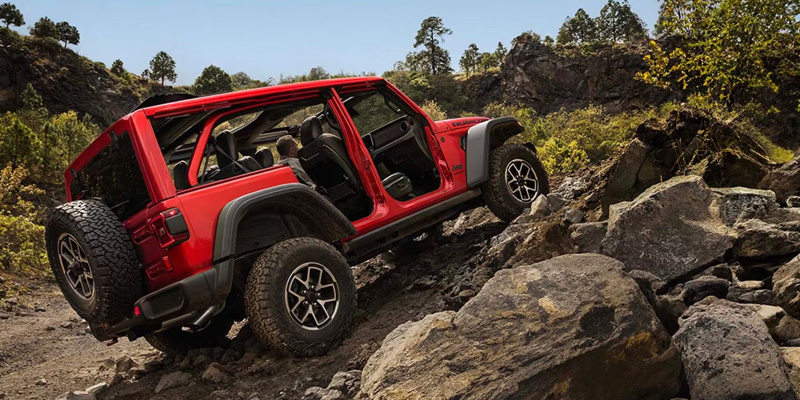
The 2026 Jeep Wrangler lineup is designed around one core principle: different trims are built to handle different types of terrain. For Oʻahu drivers, that matters more than it might in other markets. Driving conditions can shift quickly from city streets and wet pavement to loose sand, uneven trails, and elevation changes. Many shoppers comparing Wrangler trims are not just asking what features each model includes. They are trying to understand how each version of the 2026 Jeep Wrangler will actually behave across those conditions. The difference between trims is not cosmetic. It is mechanical, and those differences directly affect traction, control, and everyday usability.
How Wrangler Trims Are Structured Around Terrain Capability
Many shoppers researching the 2026 Jeep Wrangler trims ask what separates Sport, Willys, Sahara, and Rubicon. The answer is that each trim adjusts how the vehicle prioritizes terrain capability versus daily driving stability.
The 2026 Jeep Wrangler Sport provides the foundation. It includes the Command-Trac 4×4 system and solid axle construction, which allows it to handle light off-road conditions and uneven surfaces without additional specialized hardware. This makes it suitable for drivers who primarily stay on pavement but want the flexibility to handle occasional dirt or sand.
The 2026 Jeep Wrangler Willys builds on that foundation by introducing more off-road-oriented components. It typically includes more aggressive tire configurations and traction-focused tuning, which improves performance on loose surfaces without moving fully into heavy-duty off-road systems.
The 2026 Jeep Wrangler Sahara shifts toward everyday usability. It retains the same base 4×4 capability but prioritizes smoother ride behavior, interior comfort, and technology. This trim is often chosen by drivers who spend most of their time on-road but still want the Wrangler’s capability when conditions change.
The 2026 Jeep Wrangler Rubicon is engineered specifically for challenging terrain. It introduces systems designed to manage uneven traction, low-speed control, and suspension movement in environments where standard setups begin to lose effectiveness.
For Oʻahu drivers, this structure means the right trim is not the most capable one overall, but the one that matches how often those advanced systems will actually be used.
How the 2026 Jeep Wrangler 4×4 Systems Behave on Sand, Wet Roads, and Trails
Many buyers comparing the 2026 Jeep Wrangler trims want to know which model performs best on sand or off-road terrain. A 4×4 system is a drivetrain that distributes torque between the front and rear axles to improve traction when surfaces become unstable.
The 2026 Jeep Wrangler Command-Trac 4×4 system, found on Sport, Willys, and Sahara trims, is a part-time system that sends power to both axles when engaged. On sand, this helps prevent the rear wheels from spinning excessively by distributing torque forward. On wet pavement, it improves traction by reducing the likelihood of wheel slip during acceleration.
The 2026 Jeep Wrangler Rock-Trac 4×4 system, used on the Rubicon, changes how torque is delivered by introducing a lower transfer case gear ratio. This allows the vehicle to move at slower speeds while maintaining higher torque output at the wheels.
This difference becomes important in specific conditions:
- On loose sand, consistent torque helps maintain forward momentum without excessive wheel spin
- On uneven trails, lower gearing allows the vehicle to move more precisely without relying on speed
- On wet or mixed surfaces, controlled torque delivery improves stability
For most Oʻahu driving conditions, including beach access and rain, the Command-Trac system provides sufficient traction. The Rock-Trac system becomes valuable when terrain requires slow, controlled movement rather than momentum.
What Locking Differentials Actually Do in Real Driving Conditions
Many shoppers researching the 2026 Jeep Wrangler Rubicon ask what makes it more capable than other trims. The answer centers on how the Rubicon manages traction at the wheel level.
A locking differential is a system that forces both wheels on an axle to rotate at the same speed. Under normal conditions, a standard differential allows wheels to rotate independently, which is beneficial for turning but can reduce traction when one wheel loses grip.
The 2026 Jeep Wrangler Rubicon locking differentials eliminate this issue by ensuring both wheels receive equal torque. When one wheel encounters a low-traction surface such as sand or loose dirt, the system prevents that wheel from spinning freely and redirects usable force to both sides.
This changes how the vehicle performs:
- Traction is maintained even when one wheel has reduced grip
- Forward movement continues without relying on momentum
- Control improves in uneven or shifting terrain
The Rubicon also includes a sway bar disconnect system, which allows the suspension to move more freely. This increases the number of points where tires remain in contact with the ground, further improving traction.
For buyers comparing trims, these systems represent a shift from general-purpose capability to specialized off-road performance. They are most valuable when terrain conditions regularly challenge traction across individual wheels.
How Tires and Suspension Affect Grip, Stability, and Daily Driving
Many comparisons mention tires and suspension differences but do not explain how they affect real-world driving. These components directly influence how the 2026 Jeep Wrangler interacts with the ground.
Tires determine the size of the contact patch, which is the area where the tire meets the surface. A larger contact patch can improve traction on loose surfaces like sand by distributing weight more evenly and reducing sinking. More aggressive tread patterns also increase grip by channeling material away from the tire surface.
Suspension determines how the wheels maintain contact with the ground. The 2026 Jeep Wrangler suspension system on Sport and Sahara trims is tuned for balanced performance. It provides enough flexibility for light off-road use while maintaining stability on paved roads.
The 2026 Jeep Wrangler Rubicon suspension system is tuned for articulation. Articulation refers to the ability of each wheel to move independently over uneven terrain. This allows more tires to remain in contact with the ground, improving traction in challenging conditions.
These differences create tradeoffs:
- Greater articulation improves off-road traction but can reduce on-road stability
- Larger tires improve grip on sand but may introduce more road noise
- Softer suspension tuning improves terrain adaptability but changes highway feel
For Oʻahu drivers, where most driving occurs on pavement, these tradeoffs are important. Choosing a trim with more off-road capability than necessary can affect daily driving comfort.
Choosing the Right 2026 Jeep Wrangler Trim for Oʻahu Terrain
Many shoppers comparing the 2026 Jeep Wrangler trims are ultimately trying to determine which configuration actually fits how they will drive on a daily basis.
Which 2026 Jeep Wrangler trim is best for Oʻahu driving?
The best 2026 Jeep Wrangler trim for Oʻahu driving depends on how often you drive on sand, wet roads, or uneven terrain. For most drivers, the 2026 Jeep Wrangler Sahara provides the best balance of daily comfort and traction capability. The 2026 Jeep Wrangler Sport S works well for primarily on-road driving with occasional beach use, while the 2026 Jeep Wrangler Willys adds improved traction for loose surfaces. The 2026 Jeep Wrangler Rubicon is best suited for drivers who regularly encounter terrain where traction varies between wheels and need maximum off-road control.
That decision becomes clearer when you look at how each trim’s mechanical systems align with real Oʻahu driving conditions.
Based on available Wrangler inventory, most configurations are concentrated in trims that balance everyday usability with practical capability rather than extreme off-road specialization.
The 2026 Jeep Wrangler 4-Door Sahara represents the most common configuration because it aligns closely with how most drivers use the vehicle. It retains the 2026 Jeep Wrangler Command-Trac 4×4 system for traction in rain and sand while prioritizing ride comfort, interior usability, and stability on paved roads. For Oʻahu drivers navigating city traffic, coastal roads, and occasional beach access, this balance is typically the most practical.
The 2026 Jeep Wrangler 4-Door Sport S serves as a flexible entry point into the Wrangler platform. It provides the same 2026 Jeep Wrangler Command-Trac 4×4 system without additional off-road hardware, making it well suited for drivers who want traction for changing conditions but do not require specialized systems.
The 2026 Jeep Wrangler 4-Door Willys shifts toward off-road performance by introducing more aggressive tire setups and traction-oriented tuning. This improves grip on loose surfaces like sand without introducing the full mechanical complexity of higher-end trims. For drivers who expect more frequent beach or trail use, Willys provides a measurable improvement in terrain handling.
The 2026 Jeep Wrangler Rubicon and Rubicon X, which appear in smaller numbers, are designed for drivers who will actively use advanced traction systems. With the 2026 Jeep Wrangler Rock-Trac 4×4 system, locking differentials, and articulation-focused suspension, these trims are engineered for terrain where traction varies significantly across wheels.
There are also limited configurations like the 2026 Jeep Wrangler MOAB 392, which introduce higher performance characteristics and are typically selected based on specific preferences rather than general-use needs.
For Oʻahu drivers, the decision comes down to how often terrain requires more than basic traction support.
- If driving is primarily on-road with occasional sand or wet conditions, the Sahara or Sport S provides the most balanced solution
- If loose terrain and beach driving are more frequent, the Willys improves traction without sacrificing daily usability
- If terrain regularly challenges traction at the wheel level, the Rubicon’s advanced systems become relevant
The most effective way to choose between Wrangler trims is to match the vehicle’s mechanical systems to the conditions you actually drive in. When the 2026 Jeep Wrangler’s 4×4 systems, suspension behavior, and traction components are understood in real terms, the trim decision becomes a practical alignment between environment and capability rather than a comparison of feature lists.
Connect with us


- May 2026
- April 2026
- May 2024
- March 2024
- February 2024
- December 2023
- November 2023
- October 2023
- September 2023
- August 2023
- July 2023
- June 2023
- May 2023
- April 2023
- March 2023
- February 2023
- January 2023
- December 2022
- November 2022
- October 2022
- September 2022
- August 2022
- July 2022
- June 2022
- May 2022
- April 2022
- March 2022
- February 2022
- January 2022